
Portfolio construction changes once correlations matter
Every portfolio construction method embeds a view about how capital should be allocated across assets. Equal weighting assumes each asset deserves the same capital, while inverse volatility improves on that by scaling positions according to standalone risk. Minimum variance weighting takes the next step and asks how assets should be combined once their co-movement is taken seriously.
In practice, portfolio risk is not determined by individual volatilities alone. It is also shaped by correlations, concentration, and overlap between exposures. Two assets can each look stable in isolation and still contribute heavily to the same underlying source of risk when held together.
Callout
Minimum variance starts from a portfolio-level premise
Do not size positions independently. Size them as part of a system so the combined portfolio reaches the lowest achievable volatility under the chosen constraints.
From individual risk to total portfolio risk
Volatility still matters, but minimum variance weighting does not stop there. The method uses the full covariance matrix of returns, which means it considers both how much each asset moves and how those movements interact with the rest of the portfolio.
That makes the allocation problem fundamentally different from inverse volatility weighting. Inverse volatility can be understood as a diagonal approximation that ignores cross-asset covariance. Minimum variance keeps those off-diagonal relationships and therefore responds to diversification opportunities more directly.
The result is a portfolio designed to minimize total risk rather than simply reduce the influence of high-volatility assets. In many cases that leads to a smoother return profile, but it can also create stronger structural tilts and more concentrated allocations than investors expect.
Related article
Inverse volatility is the simpler starting point
If you want the cleaner bridge into risk-based portfolio construction first, the inverse volatility article shows how much of this intuition can be captured before moving to full covariance optimization.
The minimum variance portfolio
Minimum variance weighting formalizes portfolio construction as an optimization problem. The objective is to choose the weight vector that minimizes total portfolio variance while keeping capital fully invested.
Here, Σ is the covariance matrix of asset returns, which is why covariance estimation quality matters so much in practice.
Related article
What exactly is the objective function measuring
The objective wᵀΣw is just portfolio variance written in matrix form. If you want to see where that formula comes from step by step, the portfolio volatility article derives it directly from the definition of variance.
Intuition behind wᵀΣw
If we expand the objective, the variance expression breaks into two parts.
Expanding the objective
This expression has two components. The first is individual risk: wᵢ²σᵢ², which captures how risky each asset is on its own once its portfolio weight is taken into account.
The second is interaction risk: wᵢwⱼσᵢⱼ, which captures how assets move together. This is the part inverse volatility ignores and the reason minimum variance can explicitly reward diversification across the full portfolio instead of only scaling positions by standalone volatility.
Geometry of the problem
Geometrically, the minimum variance problem can be understood as a search over shapes in weight space. The expanded expression from the previous section is what gives those shapes their structure. Once we set wᵀΣw = c, we are looking at all portfolios that share the same variance level.
In two dimensions, that becomes σ₁²w₁² + σ₂²w₂² + 2ρσ₁σ₂w₁w₂ = c. That is the equation of a tilted ellipse. The contour lines are therefore all portfolios with the same variance, and in 2D those contours appear as ellipses.
The constraint 1ᵀw = 1 defines the feasible set. In two dimensions that feasible set looks like a line, and in higher dimensions it becomes a plane or simplex. Small ellipsoids correspond to lower-risk portfolios, while larger ellipsoids correspond to higher-risk portfolios. In that sense, risk behaves like distance from the origin, but distorted by the covariance structure of the assets.
Minimum variance is the smallest ellipsoid that still intersects the feasible set. That intersection is a tangency point. At that point, you cannot move along the constraint surface without stepping onto a higher-risk ellipsoid, which is exactly why the portfolio achieves the lowest possible variance.
This geometric view also explains two of the most important properties of the method. First, the solution is unique because the problem is convex: the ellipsoids are convex and the constraint is linear, so the optimizer reaches a single tangency point. Second, correlations matter because they rotate and stretch the ellipsoid, which changes where tangency occurs. That is diversification in geometric form.
Minimum variance is therefore not really about picking assets one by one. It is about finding the optimal point in a geometric space defined by risk.
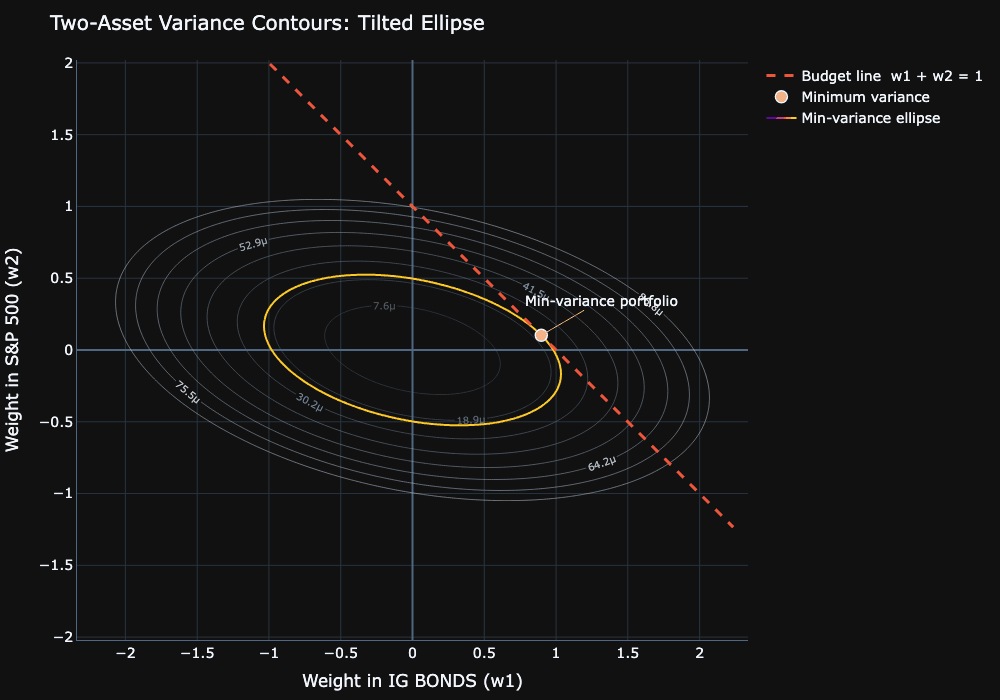
Geometric view of the minimum variance problem: covariance ellipses represent equal-risk portfolios, and the solution occurs at the tangency point where the smallest ellipsoid touches the feasible set.
The efficient frontier
The geometry from the previous section maps directly into mean-variance space. Once the problem is expressed in terms of portfolio return and portfolio volatility, the same minimum variance portfolio becomes the left-most point on the feasible set.
Every fully invested combination of assets traces out a curve in return-volatility space. That curve is the opportunity set. The minimum variance portfolio is the point with the lowest volatility on that curve, while the efficient frontier is the upper branch above that point because, for any given level of volatility, it offers the highest expected return.
So minimum variance is not separate from the efficient frontier. It is the entry point to the frontier: the portfolio with the smallest possible risk under the full-investment constraint.
This also connects cleanly back to the ellipse plot. There, the solution was the first place the budget constraint touched the equal-risk contours. Here, that exact same portfolio appears as the left-most point on the curve.
From there, moving upward along the efficient branch means accepting more volatility in exchange for more expected return. Moving downward from the minimum variance point means taking the same or more risk for less return, which is why that lower branch is inefficient.
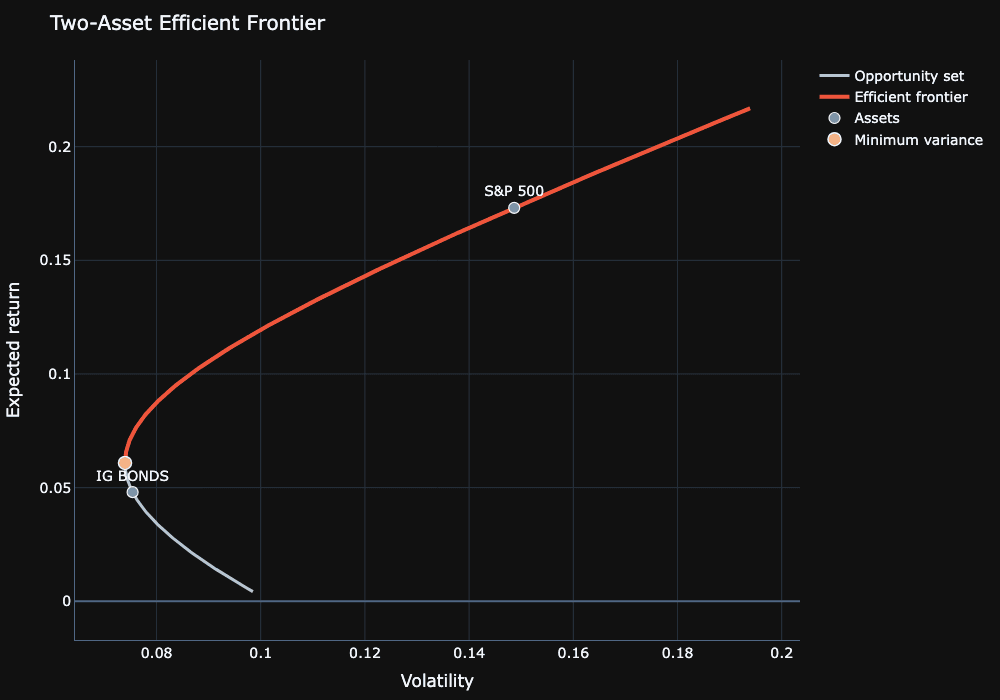
The minimum variance portfolio appears as the left-most point on the opportunity set in mean-variance space, with the efficient frontier forming the upper branch above it.
A simple minimum variance implementation
import cvxpy as cp

cov = returns.cov(ddof=1)

w = cp.Variable(len(cov.columns))
objective = cp.Minimize(cp.quad_form(w, cov.to_numpy()))
constraints = [
    cp.sum(w) == 1,
    w >= 0
]

problem = cp.Problem(objective, constraints)
problem.solve()

weights = pd.Series(w.value, index=cov.columns, name="weight")
np.round(weights*100, 2)
A constrained minimum variance implementation is often easier to express as an optimization problem directly, especially when long-only requirements are part of the portfolio definition.
Callout
A full minimum variance implementation is available in the Code & Kapital Backtesting Engine
The Code & Kapital Backtesting Engine includes production-ready minimum variance workflows with covariance estimators, constraints, and rebalance controls, so the method can be tested inside a broader research stack instead of being rebuilt from scratch in each notebook.
Minimum variance weighting in practice
strat_minvar = Strategy(
    "MinVar",
    [
        RunDaily(),
        SelectAll(),
        LedoitWolfCovariance(lookback=pd.DateOffset(months=12)),
        WeightMinVar(),
        Rebalance(),
    ],
)
This mirrors the kind of production-minded workflow used in the Code & Kapital Backtesting Engine, where covariance estimation, weighting logic, and rebalance design are treated as one integrated system. In practice, the optimization often loads up on lower-volatility names, which is one reason bounds can be useful. A constrained version might look like `WeightMinVar(bounds=(0.01, 0.4))` to keep the allocation from becoming too concentrated.
Minimum variance across a multi-asset portfolio
Monthly portfolio weights
A monthly stacked area view of a constrained minimum variance portfolio across equities, bonds, commodities, currencies, real estate, and bitcoin. In this version, each asset is bounded at 40%, which keeps the optimizer from becoming too concentrated in a single sleeve. Even with that constraint, the strategy still loads up heavily on the US Dollar, Treasury Bonds, and HY Bonds, while keeping only minimal exposure to equities for most of the sample.
Inverse volatility vs minimum variance
Inverse vol
Standalone risk
Min variance
Joint risk
Outcome
Deeper diversification logic
Minimum variance uses the full covariance structure, while inverse volatility is the simpler diagonal approximation. Both are risk-aware, but they are not solving the same problem.
What changes in practice
When applied to real data, minimum variance weighting often lowers volatility and drawdowns even further than inverse volatility weighting, because it can recognize when two low-volatility assets are still highly redundant. You can see that in the constrained example above by looking at IG Bonds, which receive lower weights because the portfolio is already carrying substantial bond exposure through Treasuries and HY. That additional structure is the main reason the method is so widely used in institutional portfolio construction.
At the same time, the optimizer can create strong structural tilts. In the constrained example above, the allocation still concentrates meaningfully in the US Dollar, Treasury Bonds, and HY Bonds, while equities remain a relatively small part of the portfolio. The portfolio can therefore become more efficient in a mathematical sense while also looking less intuitive in a capital-allocation sense.
Equal weight vs inverse volatility vs minimum variance
| Metric | Equal Weight | InvVol | MinVar | MinVar Constrained |
|---|---|---|---|---|
| CAGR | 13.0% | 7.4% | 3.2% | 3.9% |
| Volatility | 11.5% | 7.6% | 3.3% | 3.6% |
| Max Drawdown | -22.8% | -16.9% | -7.0% | -7.2% |
| VaR | -1.0% | -0.7% | -0.3% | -0.3% |
| Sharpe | 1.12 | 0.98 | 0.99 | 1.10 |
Portfolio diagnostics comparing equal weighting, inverse volatility, and minimum variance across the same multi-asset universe.
The summary table makes the trade-off clear. In this constrained example, minimum variance cuts volatility roughly in half compared with inverse volatility and also halves the drawdown profile. That is a very large improvement on the risk side, but it comes with the downside of giving up a lot of return.
In Sharpe-ratio terms, the constrained minimum variance portfolio is much more competitive and ends up closer to the equal weight portfolio than the headline return numbers alone would suggest. To make the strategies more directly comparable, a useful next step is to lever up the minimum variance strategy to match the volatility of the equal weight portfolio, which we will do in a future example.
Callout
This comparison can be produced with the Code & Kapital Portfolio Diagnostics tool
The Code & Kapital Portfolio Diagnostics tool makes it easy to compare equal weight, inverse volatility, and minimum variance portfolios side by side, so construction choices can be evaluated through risk, drawdown, concentration, turnover, and implementation behavior across the same asset universe.
What the method does not solve automatically
Minimum variance weighting does not avoid expected-return uncertainty by magic. It simply sidesteps the need to forecast returns directly. The harder problem shifts to covariance estimation, regularization, and implementation discipline, all of which materially affect the resulting portfolio.
In environments with unstable correlations, noisy sample covariances, or weak constraints, the optimizer can become brittle. That is why many practitioners still compare it directly with inverse volatility weighting: the more sophisticated method is not always the more robust one in live research settings.
Impact on portfolio volatility and concentration
Volatility
Usually lower
Concentration
Can increase
Stability
Input dependent
Minimum variance portfolios often exhibit lower realized volatility, but they can also express stronger concentration and turnover than simpler risk-scaling methods.
A different way to think about diversification
Minimum variance weighting reframes diversification as an optimization problem over the whole covariance structure. That makes it more precise than equal weight and more complete than inverse volatility, but it also makes the method less forgiving of poor inputs.
The practical lesson is not that optimization is always better. It is that portfolio construction quality depends on how risk is modeled, not just how it is measured. The better the covariance process, the more useful the optimization becomes.
“Portfolio construction is about how risk is combined, not just how it is measured.”
From approximation to optimization
Minimum variance weighting is a powerful extension of the same basic intuition that makes inverse volatility useful. It formalizes the idea that portfolio outcomes depend on how risks interact, not only on how each asset behaves in isolation.
That makes it a valuable framework for serious portfolio construction, provided the implementation is treated with the same care as the math. Good optimization does not remove judgment. It makes judgment about inputs, constraints, and process impossible to ignore.
Continue the research
Receive future research and product updates directly.
Join the newsletter for serious commentary on backtesting, data engineering, portfolio construction, and the systems behind robust quant work.